Monday, February 25, 2013

STOP! STOP! MY EARS ARE BLEEDING!!

Ok, well....maybe that's an exaggeration.  Ever get that child in your room that is talking much louder than is necessary given your close proximity?  Or maybe that child who is whispering to you and you are struggling to hear them?  This visual given to me by one of my colleagues is a lifesaver, or should I say ear-saver?


The kids really relate to this visual and enjoy trying out the different loudness levels.  Thank goodness!!

Thursday, February 21, 2013

Goldilocks and The Three Bears Speech & Language Companion Pack

What's that you say?  Someone's been eating your porridge? Oh, that Goldilocks is such a trouble maker!  It's no wonder why this story is so popular with kids!  As I'm sure you are becoming aware, I am a self-proclaimed "book enthusiast."  I love to come up with activities that target IEP goals and reinforce themes from stories at the same time.  After all, SLPs are great at multi-tasking.  Who else can manage behaviors, facilitate language and articulation, choose fun activities (that are also educational), all while taking data?

My inspiration for this project came from searching the crazy cute graphics from Scrappin Doodles.  When I saw the clip art for this story, the wheels started turning.  Here is a glimpse at what transpired...


The first thing that went through my mind was "This is perfect for PRONOUNS!!!  Now how do I make the activity so that the child is really engaged and doesn't feel like they are being drilled?"
So the activity goes like this...You choose an object to place into the prompt box.  For example, "Whose (chair) is this?"  The child then moves the picture to the response strip along with a picture of who it belongs to.  Even though my preschoolers can't read, they are learning that the printed word "says" something and they quickly pick it up.  Once they have "read" the response, they pull off the object and place it with the correct character.  I attached each character to a paper bag, which makes it perfect for containing all of the little cards.

Then I thought "How do I use this to target pragmatic development?"  Well, the story lends itself to so many opportunities to discuss feelings, talk about manners, etc. and so I thought with the use of puppets, the children could role play.  So, I made these too!


Many of the children I see have difficulty sitting for an entire session so I try to create activities that require movement, even if only taking a few steps away from the table in my cubicle.  I use my cubicle walls as a work surface very often since it doubles as a felt board of sorts.  Velcro is one of my therapy staples. In this prepositions activity, the child stands at the felt board and re-creates the picture chosen using manipulatives.

Reading can be particularly challenging for many children with speech-language delays and disorders.  Why not give them a head start with some pre-reading and early reading activities?
             

This next activity was inspired by one of my kids with a repaired cleft palate.  We have been working on discriminating between /p/, /b/ and /m/.  With "P"apa Bear, "M"ama Bear and "B"aby Bear, this "Minimal Pairs Porridge" activity worked out perfectly.

Working on Wh- questions is another "classic" IEP goal.  My groups love board games, another perfect opportunity for also working on turn-taking, and so I created a Wh- game with a Goldilocks-themed board and playing cards.

"Category Cabins" targets vocabulary development, as well as categorization through sorting.
My little Goldilocks testing it out
I also included printable worksheets with directions for at-home practice.  Having parents help with reinforcing new and emerging skills is so important and having these ready-made activities makes it so much easier!


Tuesday, February 12, 2013

Cabin Fever Anyone?

With unexpected snow days making their way around the northeast, I thought I'd introduce you to some of my favorite activities to take the edge off of those dreary days stuck in the house.  Since I love to organize (I know, it's a sickness), I actually have a "Rainy Day" notebook.  I jot down ideas, mostly from magazines (pre-Pinterest) and adapt them to target language in a fun,  hands-on way.  These are perfect to share with parents and they can keep them on hand for those unexpected days at home.


Activity #1
Edible Buildings
Things to have on hand:
Marshmallows
Pretzel sticks (the thin ones)
Directions for play:  Have your child skewer the pretzel sticks into the marshmallows and build away.  You can create buildings or a delicious friend.  You may even want to have a gummy bear stop by for a visit...

Activity #2
Bath Time Beach Party
Things to have on hand:
Dolls (the kind that can get wet)
Beach Towels (washcloths)
Sunscreen (body wash or lotion)
Boat (plastic storage containers)
Directions for play: Break out some summertime tunes and have a BLAST!  Make a fruity drink to have on hand and don't forget your sunglasses!!

Activity #3
Bath Time Car Wash (if only cleaning my car were this fun)
Things to have on hand:
Toy cars
Empty squeeze bottles
Spray bottles
Bubble Bath
Directions for play: Take those "dirty" cars and make them shine.  Dip them in the bubbles and see who gets all of the suds off first.

Activity #4
Bowling
Things to have on hand:
Empty water bottles
Ball
Food coloring
Directions for play:  Add a little water (for weight) to each bottle and secure the lids.  For an added challenge, add food coloring to one or two bottles and make those worth "extra points."

Activity #5
Hidden Treasure
Things to have on hand:
Blocks (or anything on the small side)
Aluminum foil
Empty paper towel roll
Directions for play:  Wrap the blocks in aluminum foil and hide the "treasure."  Have your little pirate use his "telescope" to find the hidden treasure.  Give them a pillowcase to put their loot!

Activity #6
Obstacle Course
Things to have on hand:
Masking tape or Painter's tape
Directions for play:  Place the masking tape in designs on the floor.  Have your child walk across the "balance beam," jump over the "bridge" or make a hop-scotch board.

Activity #7
Indoor Picnic
Things to have on hand:
Basket
Picnic-type foods
Sheet or blanket
Directions for play:  Have your child pack food for the picnic (juice boxes, raisins, string cheese, crackers, etc.) and help them set up the blanket on the floor.  Bon appetite!

Activity #8
Make A Magazine Story
Things to have on hand:
Magazines
Paper
Scissors
Glue
Directions for play:  Have your child cut out random pictures from a magazine and glue them on a few pages.  Make up a story to tell about the pictures.

Activity #9
Guess What
Things to have on hand:
Pillowcase
Stuff from around the house (phone, ball, blocks, stuffed animals, etc.)
Directions for play:  Take a walk around the house with your child and gather a few items into an empty pillowcase.  Take turns reaching inside and guessing which object you have.  Remember, no peeking!

Activity #10
Scavenger Hunt
Things to have on hand:
Paper
Pencil or crayons
List of objects (take a look at this FREEBIE)
Directions for play:  Look for objects around the house that are on the list.  Have your child draw a picture of the items he/she finds from the list.


Have fun spending time playing with your kids!  They are only this little once!!


Wednesday, February 6, 2013

Testing Time

With Annual Reviews consuming most of my waking hours, I thought this would be the perfect time to blog about testing.

Speaking from a therapist's point of view and a parent's point of view, reports that include testing results can be overwhelming and confusing.  It is always a challenge to describe the child in the most technically accurate way (to be respected by colleagues), while still making it "parent-friendly."  

For the parents reading this, the easiest way to gain understanding about how your child is doing is to speak directly with the therapist, allowing for explanation and questions. 

What is a Standard Score?
The technical answer:  A standard score is a way to compare a student's performance to that of the standardization sample of the assessment.  It is calculated based on the raw score, which is then transformed to a common scale.  It is based on a bell curve (normal distribution), which contains a mean and a standard deviation.

What does this really mean?  This is a comparison score.  In other words, this score considers how children perform compared to those children that were used in the creation of the test (a.k.a. a normative sample).

What is a Percentile Rank?
The technical answer:  A measure that tells us what percent of the total frequency scored at or below that measure.

What does this really mean?  Let's use marbles as an example, since they are all beautiful and unique no matter where they fall.  If we took 100 marbles that had the color blue in them and lined them up (least amount of blue in the "1st" spot and most amount of blue in the "100th" spot) then you could conclude that the marble in the "50th" spot (or percentile) had "as much" or "as little" blue in it as 50% of the other marbles.  The marble in the "25th" spot (or percentile) had more blue than 25% or one-quarter of the other marbles but not as much as 75% or three-quarters of the other marbles.

What is a Standard Deviation?
The technical answer:  A measure of dispersion of data from the mean.

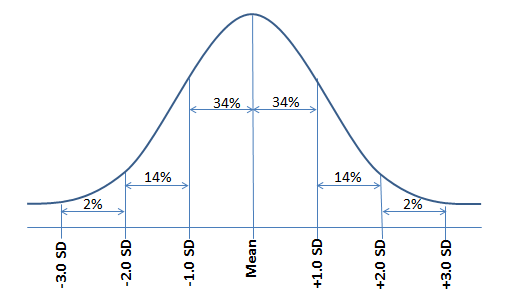
What does this really mean?  Well, before we can know the standard deviation, we need to know what we are "deviating" from.  In this case, it is the "mean" or "statistical average." I find the best way to explain standard deviation is with a visual.
When looking at this bell curve, the percentages indicated (34%, 14%, 2%) represent the percentage of the population included within this area.  In other words 68% (34% + 34%) of the population scores within one standard deviation of the mean (between -1.0 and +1.0 standard deviations).  Furthermore, 96% (14% + 34% + 34% + 14%) of the population score within two standard deviations from the mean (between -2.0 and +2.0 standard deviations).  The remaining 4% of the population score more than two standard deviations from the mean.

What is a Confidence Interval?
The technical answer:  An interval estimate of a population used to indicate reliability.

What does this really mean?  Many therapists do not typically include a confidence interval when reporting scores.  This does not make one therapist's testing better than another's.  It is yet another way to interpret the data.  In a nutshell, it is a range of numbers, which includes the standard score.  For example, let's say that a child has a standard score of 75 and a 90% confidence interval of 68-82, then we figure that the child's score will fall within this interval 90% of the time.

I could go on and on about different case scenarios, but basically, the best way to understand how your child is doing is to speak with the speech-language pathologist working with your child.  That's why we're here!

Thursday, January 31, 2013

If You Give A Mouse A Cookie Speech & Language Companion Pack

I am really EXTREMELY excited about this post.  After many, many, many hours of brain-storming, learning how to edit slides and juggle between programs, taking care of two sick kids, getting ready for a weekend away (followed by a house full of friends for the Super Bowl), I was beginning to think this would never get done.  I hope that you enjoy seeing it as much as I've enjoyed preparing it!!

It seems like the munchkins I work with always have the same goals on their IEPs.  I absolutely LOVE working with books (if you couldn't tell already from my post on repetition) and wanted to target the goals using the concepts and vocabulary introduced in Laura Numeroff's book "If You Give A Mouse A Cookie."

I always start by holding the book and looking at the cover with them.  I usually introduce it with some sort of absurdity, asking them if they think the book is about a monkey and a banana, for example.  Silly Miss Monica is always getting it wrong!! I know some teachers, therapists and parents feel that they need to read the book verbatim, without interruption until the end, but I feel that the kids internalize the experience  more when they become a part of it.  It probably takes me 10 minutes to get through a 5 minute story, stopping throughout to ask questions and encourage them to relate their own experiences (e.g. What is your favorite cookie? What do you like to drink when you are thirsty?).

Once the book is finished, I introduce a hands-on activity, whether it be "Go Fish," "Memory," or even better yet, something they can take home with them to practice with their family.


I was inspired by a freebie I downloaded over the holidays by Kara at Sped Ventures. I just loved the way all of the pieces were neatly organized.  Take a look at the interactive prepositions book I created, "A Mouse Around The House," which included vocabulary from the book:


Wondering why there are three possible places to put each piece?  Well, simply for the fact that if you ask a child to place an object "next to," for example, and the only option is a piece of Velcro in the appropriate place, you cannot really be sure if they understand the preposition or just the task of placing something where it belongs.

Another common goal for my munchkins is to use plural endings (e.g. babies instead of baby).  When targeting plurals, as in my Singular/Plural Match-Up seen here:

I usually use the cards in a "Go Fish" style activity.  By doing it this way, I am also working on sentence structure, as well as asking/answering questions and verbal turn-taking.  

Another biggie goal is identifying/labeling objects or pictures by function.  Although there are a ton of ways to target this goal, I have found a preschool favorite to be BINGO.  In this activity the calling cards are descriptions of the pictures (e.g. Something you read) and the BINGO markers are little "cookies."


There is a lot to be said about empowering a child to "read."  Using this Emergent Reader is a great way to reinforce vocabulary, increase the length of utterances and create confidence in the child.  By using repetitive sentences, the child is able to "predict" what the book is about.  It is also a great opportunity for them to associate words (even if they are not actually reading them) with spoken language.  I love being able to send them home with a book they can "read" to their family!


I also added this book-themed Game Board to use with any type of drills you need to work on.  The kids love adding cookie cereal along the path!


The final activity was created primarily for articulation goals.  Included are cookie cards for /k/, /g/, /b/ and /p/ phonemes in the initial, medial and final positions.  There are also directions and a template for making a "cookie jar" to put the cookies in after each targeted production.


This companion pack has been a ton of fun to create and I hope that you find it to be a ton of fun to use!

Thursday, January 24, 2013

A Sweet For Your Sweeties

With Valentine's Day just around the corner, I've been using cookie-themed materials to tie my activities together.  Aside from all of the great pre-made materials available, I always love the opportunity to cook with the kids. Getting young kids involved in the kitchen is such a great way to facilitate so many speech and language opportunities.  Making a mess, I mean cooking with kids, involves following directions (mix, pour, stir, measure) while incorporating senses (touching the sticky dough or soft flour, smelling the cocoa, hearing the kitchen timer, tasting the sweet sugar, and of course, watching in amazement).  Also, for those with "picky" eaters, it is a great way help them try new foods.

Here are some of my favorite cookie-themed books that are sure to be a sweet delight...

If You Give A Mouse A Cookie by Laura Numeroff


Crunchy Munchy Cookies by V.M. Racanelli


Also, for those with access to apps, consider downloading Cookie Doodle on iTunes.  The kids LOVE making digital cookies using ingredients they can mix, roll and cut.  After placing your cookie in the oven, you can decorate it.  You can even hear a crunching sound as you "eat" them!

For a fun simple game you can use to target sequencing, matching and turn-taking, download my free game "Let's Bake Cookies: A Cookie Sequencing Game" available on TpT!!


Friday, January 18, 2013

Friday's Featured Freebie

Check out this adorable penguin freebie from Carrie's Speech Corner!!


I used Carrie's idea of attaching the penguin to a container but used a plastic fish bowl (which my husband so graciously drilled into for the mouth) instead of a tissue box.  I figured it went with the whole "fish" theme and it can take quite a beating from the kids.


I then added paper clips to each little fish card as the child produced the target.


Once our penguin had eaten all of the fish, we used a magnetic fishing pole to remove each one to elicit more productions!

The kids absolutely LOVED this activity!!